Java EE Made Easy - Patterns, Architecture and Frameworks (Feb. 2018)
This post was published 8 years ago. Download links are most likely obsolete. If that's the case, try asking the uploader to re-upload.

MP4 | Video:1280x720 | Duration: 2h 1m | 249 MB
Genre: eLearning | Language: English
A beginners guide to demystifying architecture, patterns and technologies used in Java EE. Get the big picture of Java EE.
The list of Jargon used in Java EE is endless. For a beginner, Java EE can be overwhelming. The objective of the course is to give a big picture view of Java EE. You will understand the jargon, specifications, and patterns used in Java EE. You will understand the basic architecture of a Java EE application. You will get an overview of the patterns used in the Java EE world, grouped by the layer they are used in: front controller, view helper, composite view, context object, intercepting filter, domain model, façade, DTO/VO, DAO - data access object, andservice activator. You will also be introduced to terminologies like JPA, JDBC, ORM, JNDI, EJB, JTA, DTO, VO, JAXB, JAX-RS, JAX-WS, AOP and dependency injection.
Style and Approach
This course is strongly recommended to anyone who would like to get a quick overview of Java EE related technologies. The instructor gives you condensed quality information within a short span of time
What You Will Learn
Understand the basics of the evolution of the EE application architecture
Understand Model 1 architecture, Model 2 or MVC architecture and modified MVC architecture
Understand the basic patterns in Java EE: front controller, view helper, composite view, context object, intercepting filter, facade, DTO/VO, DAO - data access object, service activator
Get an introduction to terminologies like JPA, JDBC, ORM, JNDI, EJB, JTA, DTO, VO, JAXB, JAX-RS, JAX-WS, AOP and dependency Injection
Table of Contents
INTRODUCTION
HIGH LEVEL ARCHITECTURE
WEB LAYER
BUSINESS LAYER
DATA & INTEGRATION LAYERS
OTHER SIGNIFICANT THINGS YOU WOULD NEED TO KNOW
CONGRATULATIONS
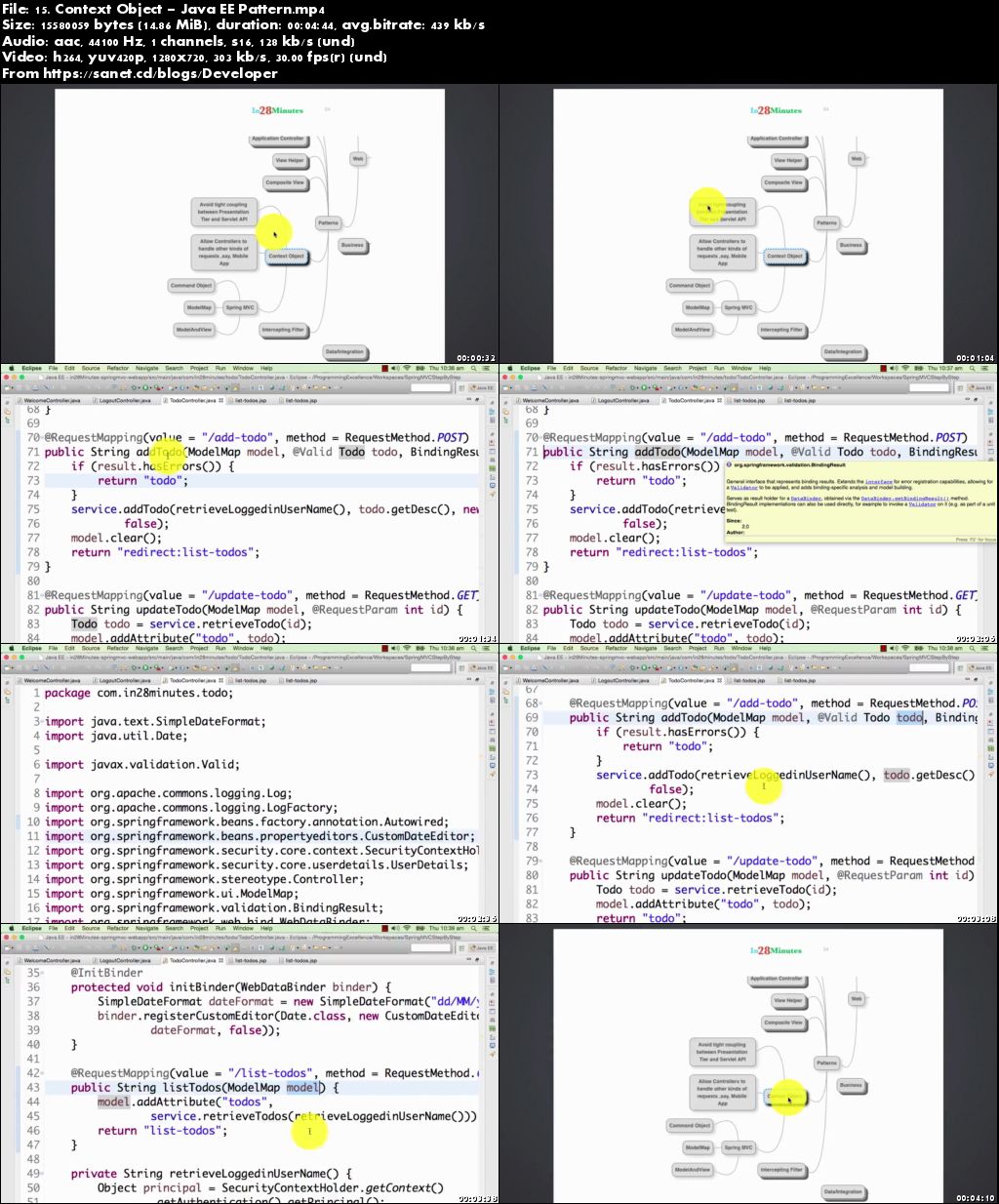
Screenshots
Quick check before we show the links
Helps us keep automated scrapers from hammering the filehosts.