Film & Video Editing With Adobe Premiere Pro - Filmmaking
This post was published 3 years ago. Download links are most likely obsolete. If that's the case, try asking the uploader to re-upload.
Published 3/2023
MP4 | Video: h264, 1280x720 | Audio: AAC, 44.1 KHz
Language: English | Size: 6.05 GB | Duration: 6h 57m
Students will learn film and video editing using Adobe Premiere: Editing, Color grading, Vsual effects & Sound Design
What you'll learn
Students will learn Learn to utilize all Adobe Premiere tools to maximize software potential and reach its highest level.
Students will learn to read and interpret a movie script to accurately represent the author's artistic and cinematic vision.
Students will learn professional post-production, including color grading (Masks, HSL, etc.), VFX, and audio editing.
Learn powerful insight about art and its relationship to storytelling through editing, so you can use any software to tackle any film project.
Gain powerful insights on art's relationship with storytelling through editing, enabling you to handle any film project with any software
Requirements
Any Adobe Premier version
No previous experience is necessary
Description
In this course on film and video editing, students will learn to use Adobe Premiere by mastering the essential fundamentals that every editor must have to tackle a film project. The course is designed to equip students with the skills to use not only Adobe Premiere, but any video editing software in the future.To succeed in video and film editing, it's necessary to have a solid grasp of the language of cinema. This language is essential for telling stories visually, and that's why this course focuses on professional projects, such as award-winning short films, scenes recorded with high-end film cameras, and completely professional music videos.Film editing is the final stage in the creation of a cinematic work, so having a deep understanding of this art is essential for developing fiction projects. In this course, you'll learn how to use rhythm, transitions, visual effects, cuts, film scripts, color correction, and professional audio editing to tell the stories you've always dreamed of telling. Importantly, this knowledge will not only enable you to tell stories through the language of film, but also to develop projects for current platforms like YouTube and Instagram.The art of film editing involves being aware of a large number of visual and sound elements that enable us to modify the order of shots, sounds, and frames for aesthetic and artistic purposes. Screenwriting and editing go hand in hand to communicate stories to the audience, and this is precisely what students will learn in this programIn this course, students will learn to utilize all of Adobe Premiere's tools to maximize its potential and take their film projects to the next level. Through the application of effective strategies, students will learn how to optimize their computer's performance and maintain a professional level of organization throughout the project.To accurately represent the author's artistic and cinematic intent, students will learn to read and interpret movie scripts, covering concepts such as shot timing, figure-ground relationships, and ellipsis.By incorporating the principles of musical and action rhythms in their editing, students will create a smooth and coherent assembly of shots. Additionally, students will learn professional color grading techniques, including the use of automated masks to add a polished finish to their post-production.Students will master the art of color correction by utilizing HSL color gamma masks, which enables precise adjustments to the color of the image. They will also learn how to stabilize images, add text to images for corporate videos, and create unique transitions through the use of varying opacities.By learning to use Adobe Premiere's audio editing tools, students can professionally edit audio without the need for specialized software, which will allow them to tell compelling stories using sound.Finally, students will learn how to properly format their work to ensure maximum compatibility across various platforms "Film editing is the art of assembling the narrative pieces of a film project." Baudilio Bey Pérez
Overview
Section 1: Introducción
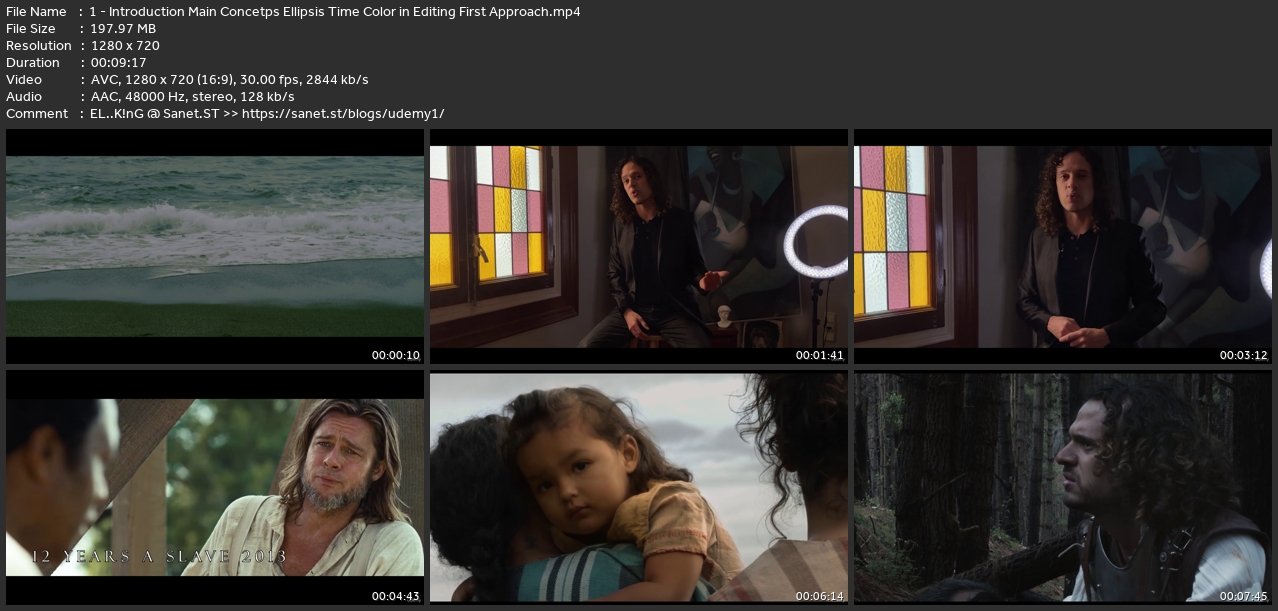
Lecture 1 Introduction - Main Concetps: Ellipsis, Time & Color in Editing / First Approach
Section 2: MODULE I - The Fundamentals of Film Editing & Video Editing - Adobe Premiere
Lecture 2 The Beginning: Setting up a project in Adobe Premiere.
Lecture 3 Learn about Adobe Premiere presets
Lecture 4 Creating a sequence: Knowing the video formats and aspect ratio.
Lecture 5 Sensitivity to images, balance and lighting
Lecture 6 Effects Control Panel: Learn about Keyframes and automations.
Lecture 7 Effects Control Panel: Learn how to use opacity and blend modes.
Lecture 8 Effects control panel: Time remapping
Lecture 9 Timeline Toolbars: Vertical Bar
Lecture 10 Timeline Toolbars: Horizontal Bar
Lecture 11 Time and the contemplation of a cinematic shot
Lecture 12 The screenplay and film editing: How a screenplay looks on the screen
Lecture 13 The screenplay and film editing: Ellipsis and direct transitions between shots.
Lecture 14 How to create proxies
Lecture 15 How to edit Texts
Lecture 16 The Export
Lecture 17 Rhythm and cuts in a Music Video
Section 3: MODULE II - Color correction and Color grading
Lecture 18 Introduction: Color correction in a scene.
Lecture 19 Color Correction Part 1: Lumetri Scopes - The Pool's Example / Cool Colors
Lecture 20 Color Correction Part 2: Pool's Example / Warm Colors
Lecture 21 Color Correction Part 3: Changing the color of elements in a shot
Lecture 22 Color Grading: Creating a mask.
Lecture 23 Color Grading: Changing the background color
Lecture 24 Color Grading final step: Secondary HSL / Precision masks.
Lecture 25 Recognizing Formats
Lecture 26 Cinematic Blurs
Lecture 27 Creating a take from another take.
Lecture 28 Stabilizing a shot.
Section 4: MODULE III - VIsual effects
Lecture 29 Introduction
Lecture 30 Adding fire to a shot: Automation.
Lecture 31 Adding fire to a shot: Final Steps & Professional Examples
Lecture 32 Adding sparkles to a take.
Lecture 33 Bonus Lesson: Cursive Letters in Motion
Section 5: Module IV: Sound Design - Audio Editing
Lecture 34 Introduction
Lecture 35 Sound design of a scene: Adding the sounds of a scene.
Lecture 36 Sound design of a scene: Adding the sounds of a scene / Actor performance
Lecture 37 Scene Sound Design: Adding Reverb and Spatiality to Tracks.
Lecture 38 Sound design of a scene: Adding effects to audio clips/ Compressors & equalizers
Section 6: FINAL
Lecture 39 ENDING
Video editors who want to delve into the cinematographic language.,Content creators on platforms who want to learn how to use adobe premier,Videographers,Filmmakers who want to learn how to edit their own work,Screenwriters
Screenshots
Homepage
without You and Your Support We Can’t Continue
Thanks for Buying Premium From My Links for Support
Click >>here & Visit My Blog Daily for More Udemy Tutorial. If You Need Update or Links Dead Don't Wait Just Pm Me or Leave Comment at This Post
Quick check before we show the links
Helps us keep automated scrapers from hammering the filehosts.