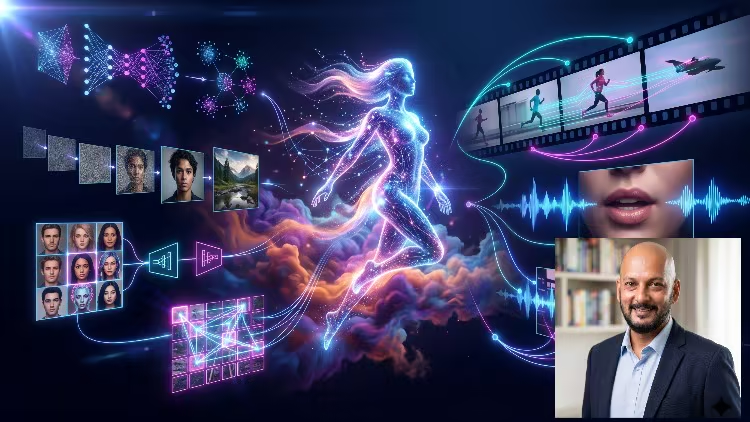
Mastering Generative Vision & Video: From GAN to Flow to DiT
Published 5/2026
MP4 | Video: h264, 1920x1080 | Audio: AAC, 44.1 KHz, 2 Ch
Language: English | Duration: 31h 39m | Size: 23.56 GB
VAEs · Diffusion · ControlNet · Flux · Sora-Style Video Generation · Audio-Visual Sync
What you'll learn
Build VAEs, GANs and Vision Transformers from scratch, understanding reparameterisation, minimax training and patch embeddings that underpin Stable Diffusion
Implement DDPM, Latent Diffusion Models and Flow Matching, understanding ODE solvers and time-step formulations used in production systems like SD 3.5 and Flux
Control and accelerate image generation using ControlNet, IP-Adapters, Consistency Models and adversarial distillation techniques like SDXL Turbo & Flux Schnell
Build spatiotemporal video generation systems using Diffusion Transformers, temporal attention and optical flow, with reference to Sora, Veo 2 and Gen-3.
Requirements
Essential Technical Knowledge: Completion of a foundational computer vision course covering CNNs, image classification, and basic deep learning — or equivalent practical experience. This course is explicitly designed as a continuation of the "Mastering Computer Vision: From Pixel to Detection to Gen-CV" course and assumes that level of preparation. Solid Python programming skills including comfort with object-oriented programming, working with libraries, and writing training loops from scratch. Working knowledge of PyTorch or TensorFlow — students should be able to define a model, write a training loop, load data, and run inference without step-by-step guidance. Basic understanding of neural network fundamentals — forward pass, backpropagation, loss functions, gradient descent, and activation functions. Familiarity with Convolutional Neural Networks and how they process image data — feature maps, pooling, and spatial hierarchies.
Recommended but Not Strictly Required: Prior exposure to attention mechanisms and the Transformer architecture is helpful, as Module 0 covers Vision Transformers at an accelerated pace assuming some prior familiarity. Basic understanding of probability and statistics — particularly concepts like distributions, sampling, and KL divergence — will help with the diffusion and VAE modules. Familiarity with Jupyter Notebooks and running experiments on cloud GPU environments (Google Colab, Kaggle, or similar).
Hardware and Software: A computer capable of running Python 3.8 or higher with standard deep learning libraries installed. Access to a GPU environment for running labs — cloud GPU platforms are acceptable and recommended for students without local GPU resources. No specialized hardware is required beyond access to a free-tier cloud GPU for practical lab sessions.
This course is NOT suitable for: Complete beginners to deep learning or Python programming. Students with no prior exposure to convolutional neural networks or image classification. Those looking for a no-code or prompt-engineering course — this is an implementation and architecture-focused engineering course.
Description
Mastering Generative Vision and Video: From GAN to Flow to DiT
The Complete Engineering Guide to Modern Generative AI — Images, Video, and Audio-Visual Synthesis
Generative AI is no longer a research curiosity. It is the engine behind billion-dollar products, production pipelines at studios and startups, and the most sought-after engineering skillset in the AI job market today. Stable Diffusion, Sora, DALL-E, Runway, Midjourney, Kling, and Veo — every one of these systems is built on the architectural foundations this course teaches from first principles to production implementation.
This course picks up exactly where classical computer vision ends. You already understand CNNs, segmentation, and detection. Now it is time to master the generative side — the models that do not just recognize the visual world, but create, transform, and synthesize it.
"Mastering Generative Vision and Video: From GAN to Flow to DiT" is the only course that takes you through the complete evolution of generative architectures in a single, coherent learning journey. You will start with the foundational building blocks — Variational Autoencoders, GANs, and Vision Transformers — and progressively advance through Latent Diffusion Models, Flow Matching, ControlNet, Consistency Models, and finally Diffusion Transformers (DiT), the architecture powering Sora and the next generation of video generation systems.
The curriculum is structured around five modules covering 19 lectures of hands-on, implementation-focused content.
Module 0 ensures every student has the right foundation with VAEs, GANs, and ViT before entering the diffusion world.
Module 1 takes you from DDPM probability theory all the way to Flow Matching and ODE solvers.
Module 2 dives deep into control and acceleration — ControlNet, IP-Adapters, LCM Distillation, SDXL Turbo, and Flux Schnell.
Module 3 introduces spatiotemporal generation for video, covering DiT-based architectures, Sora, Veo 2, temporal attention, optical flow, and frame interpolation.
Module 4 closes the loop with generative audio-visual synchronization — neural audio synthesis with AudioLM and MusicGen, unified AV generation with Veo, lip-sync architectures with Wav2Lip, and latent audio-video alignment metrics.
This is not a course about prompting or using AI tools. This is an engineering course. You will understand the mathematics, implement the architectures, and build systems capable of generating images, videos, and synchronized audio-visual content.
Whether you are an AI engineer wanting to work on foundation model teams, a researcher building the next generation of generative systems, a developer integrating generative capabilities into production pipelines, or a technical entrepreneur building a generative AI product, this course gives you the complete, rigorous, and practical foundation to do it.
The demand for engineers who understand these systems at an architectural level is growing faster than the supply. This course is your path to becoming one of them.
Who this course is for
1. AI engineers and developers who want to move beyond recognition tasks and build generative image, video, and audio-visual systems using diffusion models, flow matching, and transformer architectures.
2. Students who have completed a foundational computer vision course and are ready to advance into generative AI, learning the architectures behind Stable Diffusion, Sora, ControlNet, and Veo.
3. Machine learning researchers and practitioners who want hands-on implementation experience with state-of-the-art generative models including DiT, LCM, SDXL, Flux, and audio-visual synthesis systems.
4. Software developers and technical entrepreneurs building generative AI products who need architectural understanding beyond prompt engineering to integrate and customize foundation models.
5. Data scientists and deep learning engineers looking to specialize in generative vision and video, one of the fastest growing and highest paying areas in the current AI job market.
Quick check before we show the links
Helps us keep automated scrapers from hammering the filehosts.