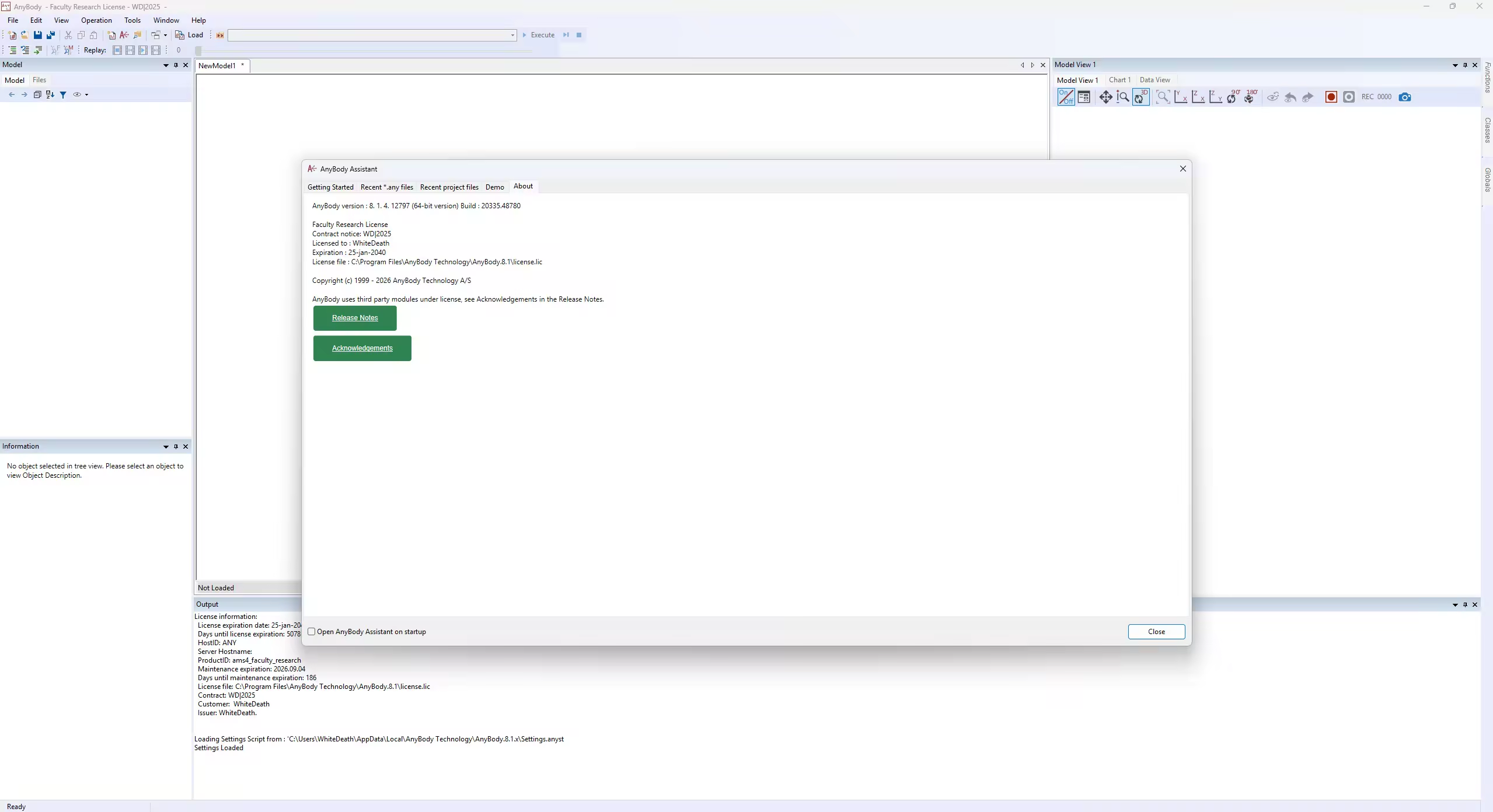
Anybody Technologies Modeling System v8.1.4.12797 (x64)

x64 | File Size: 729 MB
Description
AnyBody Technology is a pioneer and leading provider of mechanical modeling of the living body, in particular musculoskeletal modeling (MSM). The all-dominating area of application is of course the human body, but our technology applies to analysis of any creature – currently living, pre-historic, or imaginary. Our base technology is the AnyBody Modeling SystemTM – the simulation engine – and the AnyBody Managed Model Repositories for instance containing the world’s most comprehensive human full-body musculoskeletal model.
Modeling and simulation software
We deliver the AnyBody modeling and simulation software, models, and a variety of assisting tools for a setting up a full simulation tool chain. We also provide simulation consultancy service for your specific R&D purposes, or as support and assistance to your in-house simulation resources.
Why Use Musculoskeletal Modeling Software?
-Musculoskeletal modeling is a computational way to investigate the mechanical functions of the living body.
-Musculoskeletal models output loading in all muscles, joints, and potentially other tissue of the body, as well as potential derived quantities targeting for instance loading of devices, ergonomic analysis, human performance in sports, and the development of cutting-edge designs. Augment laboratory and field studies with biomechanical analyses and use simulation studies as in-silico evidence of the efficacy and safety of your device.
-Simulation can make qualified estimation of properties inside the body, which are mostly impossible and unethical to measure – Simulation is the only alternative.
For the exact same reason comprehensive validation can be difficult, but we, together with our many closer users and partners, are striving to provide the best possible verification and validity indicators of our distributed models – see our comprehensive publication list and webcast library.
System Requirements
OS:Windows 10 or higher
CPU:Intel Core i5 processor, AMD Athlon/Phenom™ x4 processor, or better
Space:1 GB free hard disk space depending on accessory applications installed
Memory:8 GB RAM
GPU:3D Graphics accelerator card with OpenGL version 3.2 or better
Display:Full HD monitor
Hardware:Wheel mouse, or 3D mouse
Whats New
Bug Fixes
-Fixed two issues related to the min-max muscle recruitment criteria (MR_MinMaxStrict and MR_MinMaxAux) and solvers
-The min-max problem input to the solvers has been improved by removing redundant constraints. Previously, the bound formulation of the min-max criteria imposed upper and lower bounds on all recruited forces. This version removes bounds that were redundant with other constraints on muscle activity (e.g., standard non‑negativity). This reduction should not change results and appears to improve robustness of the min-max solvers. In particular, MR_MinMaxStrict, which is known to be less robust than other solvers, improved in our tests. The previous formulation (including all objective-related bounds) is retained to enable compatibility investigations. It can be re-enabled with the compatibility option System.Compatibility.AnyBody80_AllMuscleRecruitmentMinMaxBoundsOnOff. This option existed in earlier 8.1 versions (affecting only MR_MinMaxAux) where it was On by default. In this version it is Off by default and now applies to all min-max criteria.
-Fixed a bug in the default value of InverseDynamics.Criterion.SolverActivityUpperBound, which was incorrectly set to the low value 1e-3. The default should be either a large value or zero to disable the option. In earlier 8.1.x versions it was applied only when InverseDynamics.Criterion.Type = MR_MinMaxAux. In that case it led to unintended low upper bounds (1e-3) on all recruited forces that had no other upper bound (typically not muscles, which have physiological bounds overriding this default). The default is now 0.0, implying the option is normally not needed with the updated solvers.
-Fixed a regression with AnySurfCylinderFit that shifted the cylinder by half its length along its axis after updating values in the Model Tree.
- Fixed an issue in AnyOutputFile where header names for single-value vectors were formatted as scalar names. Such vectors now include the index postfix[0].
-Added missing member descriptions in the AnyScript Reference Manual.
-Fixed the link generator for message descriptions in the AnyScript Reference Manual.
Minor Updates
-Embedded Python updated to 3.13. Python 3.8 and earlier are no longer supported for Python Hooks (As Python 3.8 is end-of-life).
-The external Python environment (set via ANYBODY_PATH_PYTHONHOME) no longer needs a pythonXXX._pth file to load correctly.
Quick check before we show the links
Helps us keep automated scrapers from hammering the filehosts.