Luka Kuplowsky - The Grass Grows, Antonych Grows (2026)
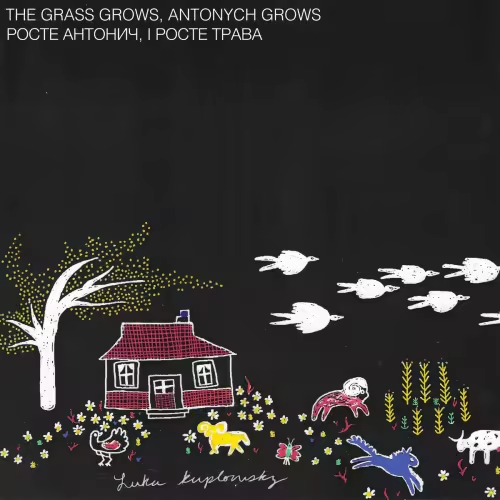
FLAC (tracks) 24-bit/48 kHz - 317 Mb | WEB FLAC (tracks) - 148 Mb | MP3 CBR 320 kbps - 73 Mb | Front Cover | Time - 29:32 minutes
Folk, Ambient, Jazz, Poetry | Label: Next Door Records, Official Digital Download
Luka Kuplowsky’s recent musical endeavors proposes a persistent question: how might a poem travel? Celestial sound. The forest speech. Worms slumbering into song and decay. The language of meadows muttering infinity. Moon composing elegies on dust. To adapt the poetry of the orphic Ukrainian poet Bohdan Ihor Antonych (1909-1937) to song, is to find the songwriter in a state of uncertainty: “am I mediating a poem? A vision? Or some force beyond the senses?”
Immersed in synthetic and organic sounds, swelling in sparkling brightness and tubby warmth, Luka Kuplowsky’s The Grass Grows, Antonych Grows (Росте Антонич, і росте трава) is akin to transcribing a waking dream; a potent image dissolving into the real. Antonych himself often wrote his poetry in the urgency of the morning light, quickening out of bed to capture the fever and travels of his night dreams. Through flashes of pastoral utopianism, apocalyptic visions and cross-modal synaesthesia, Kuplowsky, alongside an ensemble of Toronto’s very finest collaborators, render a vivid, brilliant world that invites Antonych’s poetry into unexpected and resonant relations of language and sound.
While Kuplowsky’s 2024 double album How Can I Possibly Sleep When There Is Music embraced process in the web of poetic connection that arose in interpreting the poems of Zen Buddhist poet Ryōkan Taigu, The Grass Grows, Antonych Grows narrows its focus, drawing upon Antonych’s poetry to explore his philosophical preoccupations with Lemko paganism, modernist poetry, and a metaphysics concerned with a search for eternity. Yet, the focus is relative. If How Can I Possibly Sleep stretched out from Ryōkan towards a millenia of poets (Du Fu, Rumi, Rilke, W.W.E Ross, Li Bai, Yosano Akiko etc..), here Antonych’s poems are a vehicle for stretching out towards everything, taking in plants, the solar-system, bugs and the cosmos. Antonych offers a song of transcendence, earthly and spiritual. And Kuplowsky, a century later, enters the cyclical stream of Antonych’s mythopoetic travels.
Bohdan Ihor Antonych is a striking and singular figure in Ukrainian poetry; an outsider and spiritualist who offered Ukrainian poetry a cosmic realm outside of political dogmatism and realism. Born in the Lemko village of Novycja, in the Austro-Hungarian Empire, on the eastern edge of modern-day Poland, his relationship to the Ukrainian language was cultivated through its ancient roots in the Lemko dialect, only later encountering and devoting himself to the language and culture of Ukraine after entering University in Lviv. In his brief life, Antonych produced six books of poetry (two released posthumously), that bridge an image of an idyllic pastoral past and the chaos of his present: world wars and revolutions. In his poems, sensuous images of the poet as plant, bug and grass brush against images of apocalypse, “walls of fire” and “storms of bells”. While he inherits a Ukrainian poetic tradition that encompasses forefathers like Taras Shevchenko and Antonych’s contemporary Pavlo Tychyna, he also stands amongst the great modernist poets like Rainer Maria Rilke, T. S. Eliot, Federico Garcia Lorca, and Czeslaw Milosz, Walt Whitman and Dylan Thomas; a visionary strain of poetry concerned with transcending and transforming reality. Arriving at the Ukrainian language as an outsider, yet intimate with the regional mythology (and demonology) of the western slavic regions, Antonych’s liminal status drew out nuances of the language that felt unusual yet familiar; an ancient refrain from a pastoral future-past.
Kuplowsky too arrives at Antonych and Ukraine in a state of liminality. Raised of Ukrainian-Irish heritage in Canada, his relationship to Ukraine is not one of language and nation, but rather culture and family; the traditional dances, seasonal rituals and singing he participated in growing up, as well as the poetry, music, filmmakers he continues to dialogue with. Antonych did not have attachments to a Ukrainian state, but held beliefs in the endurance of its people, language and culture. Antonych looked past the nation towards the spiritual, while the apocalyptic visions of his poetry responded to, and perhaps foresaw, the great human loss of the twentieth and twenty-first century. Interspersed throughout the record, three poems of Antonych's are recited in Ukrainian. A soundscape of ping-ponging vocals resonate as Kuplowsky’s relatives in Western Ukraine speak Antonych’s verse into a cell phone, their voices traversing a great distance over farmland, cities, battlefields and oceans.
“I am a bug”, Kuplowsky intones on the third song of the album. Later, he imagines himself simultaneously as a blade of grass and the poet bending down towards the grass. In a sublime moment of transcendence, “Plant Life” renders a mystical evening in a poet’s study as book, plant, and stars coalesce in an audio-poetic montage of spiritual and physical growth. Kuplowsky wrote the record in what he described as a “trance state,” simultaneously writing and tracking a version of the album over six days, arranging and collaging Antonych’s poetry into song on his Yamaha PSR. Bringing the songs to his collaborators months later, the record retains the traces of Kuplowsky’s demos (drum machines, synthesizer), yet opens into a wide scope of jazz, new age and cosmic balladary. In a sense, it is a very Toronto record.
To those uninitiated in Toronto’s tradition of songwriter-experimentalists, Kuplowsky emerges from a scene of recognized and under-the-radar artists that eschew genre for a free-play of lyrical and sonic explorations. The Tranzac, an unassuming social club-turned-performing-arts- non-profit in the Annex neighborhood, has largely served as the incubator and hub for the growth of this sound. Bands and artists like Deep Dark United, Jennifer Castle, Sandro Perri, Eucalyptus, The Silt, and Eric Chenaux contributed to shaping this distinct strain of the Toronto sound in the early aughts; songwriting that opens up space for experimentation. A sound open to diversion, heterogeneous rhythms, and rich, soulful melody. A sound that mines the interval between a song and a sound. This is the natural outcome of a space like the Tranzac where dinner-time folk-music is followed by late night free-jazz. The players of The Grass Grows, Antonych Grows in one way or another have affinities with this scene and sound, and the album’s core collaborators (Evan Cartwright, Josh Cole, Thom Gill, Felicity Williams), share not only roots in the Tranzac but have played alongside Kuplowsky for over a decade. Even with their long-held collaboration, the record’s sonic palette is remarkably fresh: Kuplowsky has temporarily put down his nylon string guitar; Cartwright balances drum programming and the occasional sprint of jazzy fills; Gill primarily plays keyboards, laying a warm pillow for Kuplowsky’s voice and constructing an array of sonic treats; Cole adopts an equally dubbed out and melodic approach to his bass playing; and Williams pares her acrobatic vocalizing on How Can I Possibly Sleep for soft doubling and layered soundscapes that feature in the album’s three interludes. The album also features first-time collaborations with stalwarts of the Toronto scene whose offerings of sax/EWI (Joseph Shabason), vibraphone (Michael Davidson), clarinet and flute (Daniel Pencer) beautifully embellish the record’s eclectic palette. One might describe it as reminiscent of the ornate arrangements of Ryuichi Sakamoto and David Sylvain’s collaborations in the eighties or nineties, but one might also listen locally and recognize the sonic touches of its collaborators: Thom Gill’s melodious and surreal sonic engineering in pop-savant Bernice’s Cruisin’; Evan Cartwright’s blend of jazz harmony and field recording on his solo record bit by bit; Josh Cole’s fretless bass playing on Sandro Perri’s Soft Landing; or engineer and mixer Joseph Shabason’s slew of solo and collaborative projects over the last half decade (including Shabason & Krgovich, Fresh Pepper, & Cici Arthur).
On the striking celestial ballad “Home Beyond the Star”, Kuplowsky, as Antonych, describes a union between heaven and earth, the pursuit of an impossible intoxication, the musicality of all things. In a Whitman-esque reappraisal of Descartes’ Cogito, ergo sum, the poet has a revelation: “As long as I am here/I sing therefore I am.” Antonych’s song of transcendence is picked up by Kuplowsky. And in song, they are.
All songs adapted or based on works by Bohdan Ihor Antonych Богдан-Ігор Васильович Антонич
The Green Music Players
Daniel Pencer: Clarinet, Flute
Evan Cartwright: Kit, Perc, Drum Programming, Kalimba
Felicity Williams: Voice
Josh Cole: Electric Bass
Joseph Shabason: Tenor Saxophone, EWI
Luka Kuplowsky: Voice
Michael Davidson: Vibraphone
Thom Gill: Synthesizers, Piano, Wurlitzer, Guitar, Perc
Tracklist
01 Ліс
02 You Are Music
03 I Am a Bug
04 The Grass Grows, Luka Grows
05 Весна
06 Plant Life
07 A Proud Plant That is Myself
08 The Home Beyond a Star
09 Spring!
10 Сурми останнього дня
11 Storm is Near
Quick check before we show the links
Helps us keep automated scrapers from hammering the filehosts.