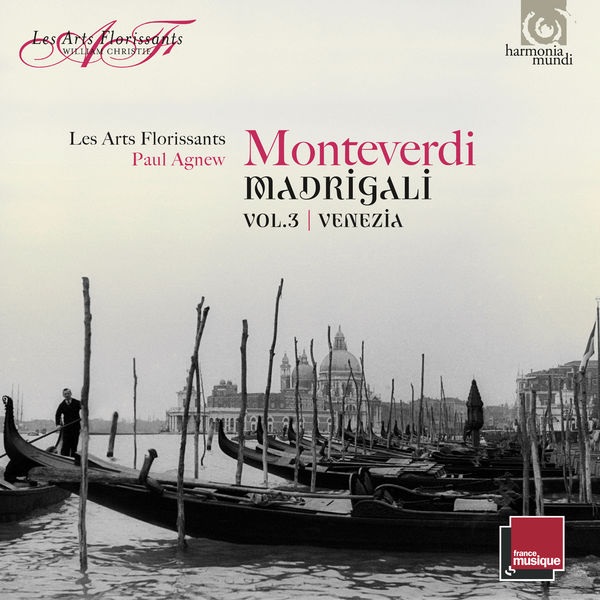
Monteverdi - Madrigali vol. 3: Venezia - Les Arts Florissants, Paul Agnew (2017)
This post was published 8 years ago. Download links are most likely obsolete. If that's the case, try asking the uploader to re-upload.
EAC Rip | FLAC (tracks+.cue, log) | Artwork | 306 mb | MP3 CBR 320kbps | RAR | 100 mb
Classical / Renaissance / Baroque / Madrigal | Label: Harmonia Mundi | HAF 8905278
Recorded at the Cité de la Musique during the complete cycle of Monteverdi madrigals mounted in partnership with the Philharmonie de Paris and the Théâtre de Caen, the last volume in our trilogy probably contains the best-loved gems of a composer who had become maestro di cappella at St Mark’s in Venice, and finally entered the priesthood. Alongside the great operas that have survived from this period, the final madrigals methodically explore the multiple possibilities offered by the rapidly developing practice of basso continuo and by an unprecedented exploitation of solo voices. And, in that respect, the celebrated 'Combattimento di Tancredi e Clorinda' forms a spectacular finale to our Monteverdian adventure!
Claudio Monteverdi is usually regarded as an early Baroque composer, though he was actually a transitional figure between the Renaissance and Baroque periods, and his music gradually changed from the prima prattica or the older polyphonic choral style perfected by Palestrina, to the innovative use of solo voices with instrumental accompaniment, known as the seconda prattica. This evolution is evident in Monteverdi's eight books of madrigals, which were published between 1587 and 1638. Paul Agnew and Les Arts Florissants performed the entire cycle of madrigals on tour between 2011 and 2015, and released them on Harmonia Mundi in three volumes, of which this is the last. The album, subtitled Venezia, which includes the seventh and eighth books, was recorded live, and features works that Monteverdi composed when he was maestro di cappella of St. Mark's in Venice. The development of the seconda prattica is perhaps most apparent in Il combattimento di Trancredi e Clorinda, an operatic scene for three voices that is also notable for its novel division of the string orchestra into four sections, and the use of special string techniques, such as pizzicato and tremolo. Agnew and his musicians employ one voice per part and use period instruments, so the feeling of the performance is intimate and quite dramatic, and demonstrates the range of textures, effects, and tone colors available to Monteverdi. Because these are live performances, their spontaneity and freshness give a good idea of the heightened expressions Monteverdi sought in his later madrigals and operas. Highly recommended.
Tracklist
01 - Settimo Libro - Tempro la cetra, SV117 - Sinfonia
02 - Settimo Libro - Al lume de le stelle, SV138
03 - Settimo Libro - Con che soavita, SV139
04 - Settimo Libro - Chiome d'oro, SV143
05 - Settimo Libro - Interrotte speranze, SV132
06 - Settimo Libro - Lettera amorosa, SV141
07 - Settimo Libro - Ballo. Tirsi e Clori, SV145
08 - Ottavo Libro - Altri canti d'Amor, SV146
09 - Ottavo Libro - Dolcissimo usignolo, SV161
10 - Ottavo Libro - Lamento de la ninfa, SV163
11 - Ottavo Libro - Combattimento di Tancredi e Clorinda, SV153
Musicians:
Les Arts Florissants
Paul Agnew - direction
Quick check before we show the links
Helps us keep automated scrapers from hammering the filehosts.