Social Media and Journalism
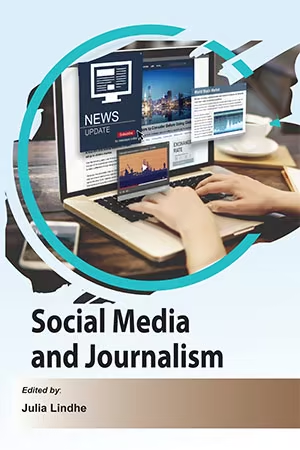
Julia Lindhe | 2023 | ISBN: 1682508498 | English | 316 pages | True PDF | 11 MB
The rise of internet and mobile apps as popular gateways of news consumption, has profoundly changed what constitute journalism. The interactive features of social media have transformed journalism into a forum whose primary function is exchange of views. Blogs, YouTube, Twitter, Facebook and the like have become increasingly central to the dissemination of news.'Fast' and 'short' being the dominant logic of the web platforms, quantity rather than quality gets more attention. The huge inflow of information through the unofficial channels makes journalism more of a desk job leaving less time for field work and research. With technical tools in hand, journalists produce more and faster. Emphasis has shifted from research and content to production and form. Audience empowerment has redefined authorship to an extent that, today journalists and audiences act as partners in news making. Social media and journalism go hand in hand and, despite what many purists would say, the increased digitization of our society has only enhanced this field.
This book presents a comprehensive investigation of the ways in which social media has affected change to the constitution of mainstream journalism. The mushrooming growth of social media services hugely expanded the scope of content generation and sharing. Social platforms have not only emerged as important news platforms for the public, but also as useful tools for journalists. Journalists use social media to find story leads and to share their work with audiences, which has made journalism more interactive. As the social media technologies have variety of features tailored for specified functions, journalists use different social media tools for different journalistic functions, which this book attempts to explore. Today, journalists face challenges caused by new media technologies. Journalism is experiencing considerable changes linked to social, cultural, economical, and technological transformations. Social media brings new characteristics like interactive dialogue and social interactions. Journalists can now have real conversations with their audience. Online debates have also been put into place so that everyone can express themselves. Traditional one-way communication is turning into two-way conversations. Social media has given a real meaning to what freedom of speech is. In history, expressing yourself has never been so easy. This book is for understanding how today's journalists and news organizations use mobile and social media to gather news, distribute content, and create content.
Quick check before we show the links
Helps us keep automated scrapers from hammering the filehosts.